
The Roadmap
The main target audiences of the roadmap are Technical Boards responsible for overseeing the standardisation programme within the two European Standards Organisations: CEN and CENELEC and the European Commission to consider RISERS findings and recommendations in the preparation of the annual EU work programme for the European standardisation.
When developing the Roadmap, RISERS will liaise, when relevant, with the High Level Forum on European Standardisation contributing to its objective to support a more green and resilient single market by identifying future standardisation priorities.
Our Roadmap for (IS) Standardisation will be based on 5 core elements
Definition of priority synergies and resources
Identification of opportunities for synergies within and across sectors
A comprehensive mapping of the existing industrial symbiosis standardisation landscape
Evidence base provided by R&D
Engagement, collective knowledge and experience of experts and practitioners from diverse sectors including industry, policy, academia, and standardisation bodies

Following the broad scope of resources provided by the CWA definition of IS, the RISERS Roadmap will focus on three key streams: materials, energy or services as subjects of symbiosis which can be shared or exchanged between the sending (source) and the receiving (sink) sectors that participate in IS synergies.
Materials
Resources, waste , emissions, critical materials, by/side products, etc.

Energies
Heat/steam, electricity, nuclear, hydrogen, renewable energy sources, etc.

Services
Facilitation, infrastructure, logistics, transport, engineering, platforms, etc.
Material exchanges contribute to the circularity and zero-pollution strategy, energy exchanges support the climate neutrality ambitions while services contribute to the green and digital agenda.
The foundation for the RISERS roadmap is a thorough assessment of the current standardisation landscape in support of IS. Based on this assessment, gaps will be identified and validated with stakeholders during dedicated engagement workshops. These workshops will result in recommendations for further actions in standardisation.
The Roadmap will consider two directions of action

revising current standards (especially for well-known synergies)
initiating the process of new standards development (especially for newer technologies and pilot-scale synergies).
New standards can be developed by existing technical committees, or where no suitable technical committees exist, RISERS will recommend establishing a dedicated new body.
Development of core elements of the IS Standardisation Roadmap
The existing industrial symbiosis standardisation landscape
The interactive graphic shows the assignment of all around 800 international and European technical committees (TCs) to the most important sectors for industrial symbioses (IS)

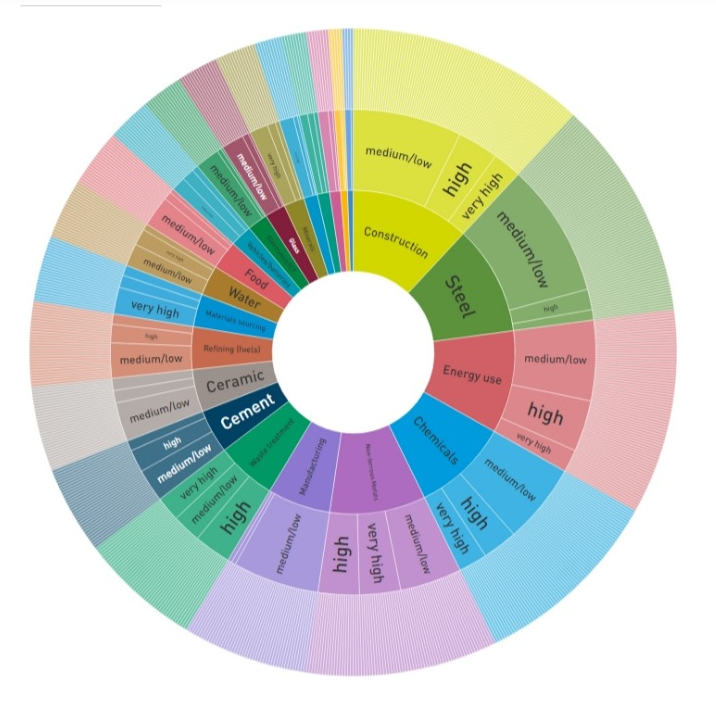
The Interactive Standards Mapping, was developed by DIN (German Institute for Standardisation) and is accessible on the DIN website: https://din.de/go/risers
It is an interactive tool designed to facilitate industrial symbiosis. The wheel-shaped map is divided into segments, with each one representing a specific resource crucial for industrial operations.
These resources include: construction, steel, energy use, chemicals, non-ferrous metals, manufacturing, waste treatment, cement, ceramic, refining (fuels), materials sourcing, water, food, vehicles/batteries, electronics/ICT, glass, minerals, lime, pulp and paper, textiles, fertilisers, and services (related to IMS/Data exchange).
Users can navigate through the wheel and explore different resources. Each resource is further divided into three levels: medium/low, high, and very high. Within each level, users can find the number and topic covered by each standard. This provides insights into the regulatory landscape within various industrial sectors.
10 high-potential high-priority synergies and resources for IS identified
Find out the selection of high-potential and high-impact synergies and resources most relevant for IS in Europe’s key sectors as leads for the standardisation roadmap
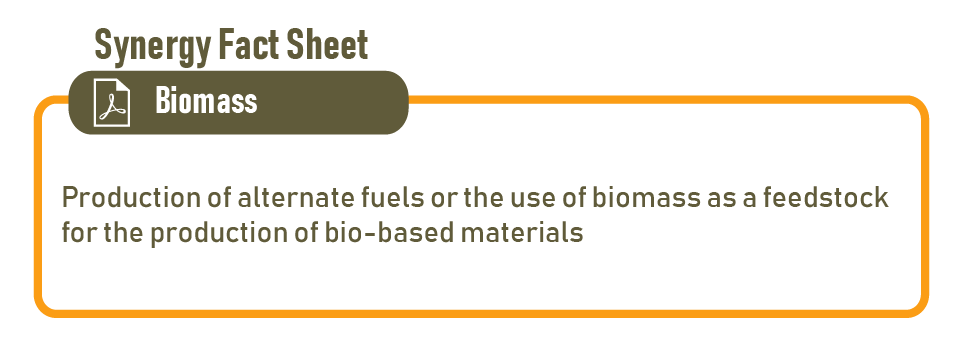
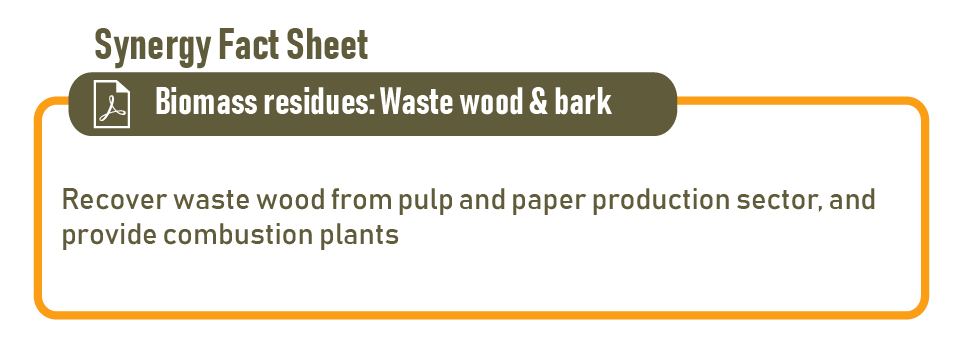
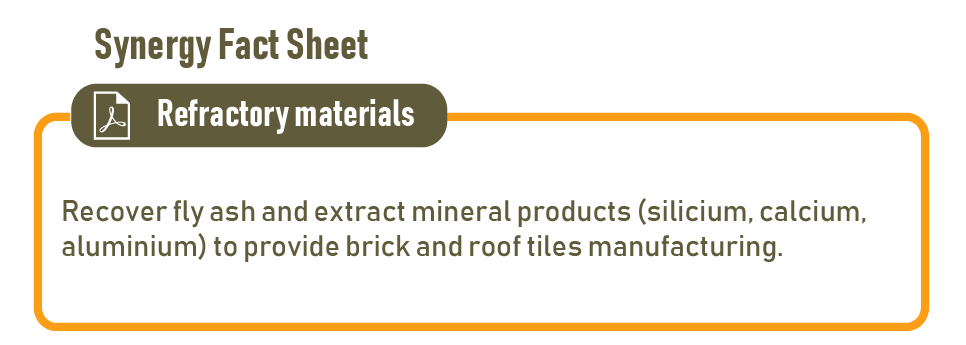
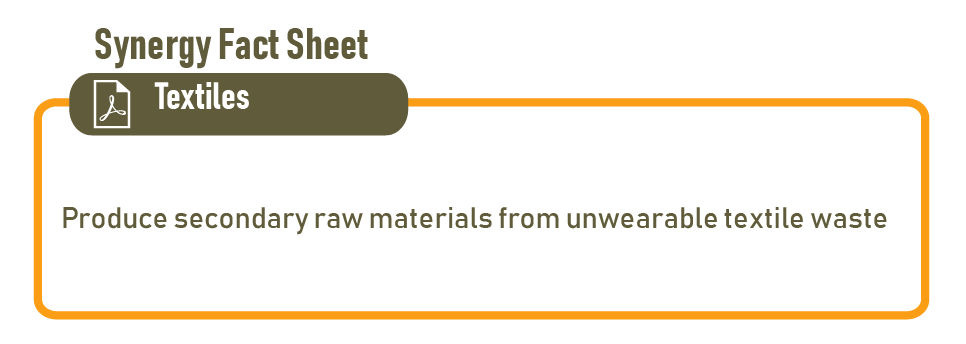
The Horizon Europe RISERS project, led by Enspire Science with key partners, is driving forward industrial symbiosis (IS) by identifying 10 high-potential and high – impact synergies. As part of this initiative, RISERS has also released a series of 10 fact sheets, offering practical insights into the 10 identified impactful IS synergies across Europe.
To arrive to the 10 key synergies, an extensive database of over 600 unique IS synergies from urban-industrial and cross-sectoral clusters was compiled, mapping over 300 MES streams ( Materials , Energies and Services) and source and sink sectors for innovative resource exchanges. Using the LESTS method (legal, economic, spatial, technical, and social indicators), 50 high-impact IS cases were shortlisted, ensuring alignment with sustainability priorities. Each case was then evaluated based on the 3Ps: People, Planet, Profit, highlighting economic, social, and environmental benefits. From the top 50 cases, 10 high-impact synergies were selected based on:
- cross-sectoral or urban-industrial exchanges, avoiding intra-sectoral overlaps
- high impact in at least one 3P category (People, Planet, Profit)
- alignment with RISERS’ priority sectors covering up to 7 process industries, energy and bio-based sectors, and an emerging sector.
The identification of the 10 key synergies and the fact sheets builds on the work done in previous EU H2020 projects, such as MAESTRI, SCALER and EPOS and data available from literature and public sources.
What’s in the Synergy Fact Sheets?
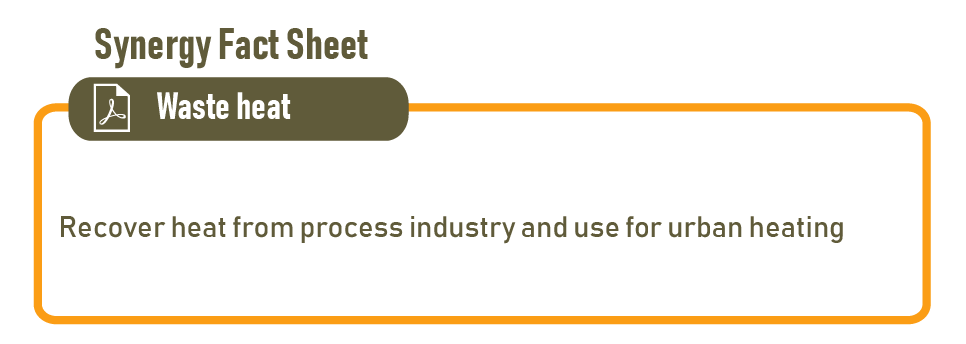
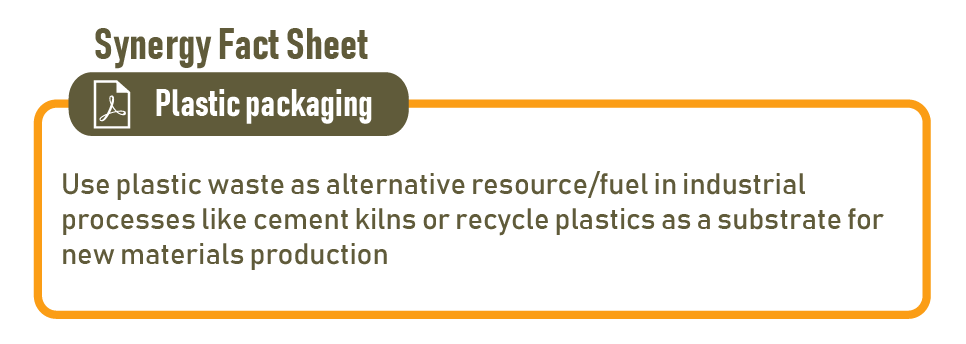
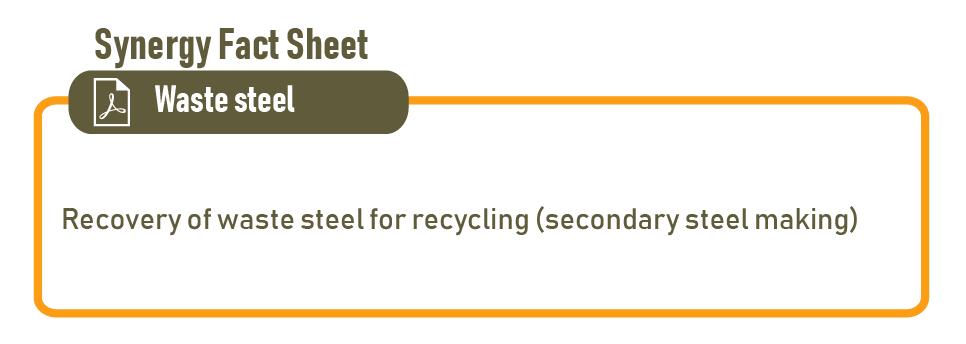
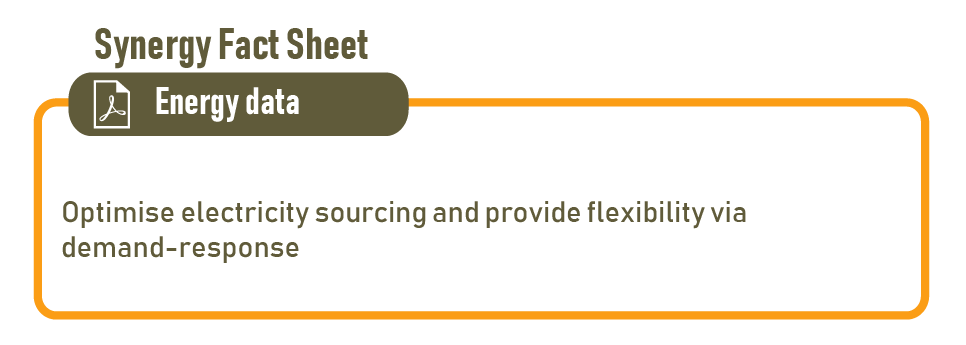
Each fact sheet is specific for the synergy and provides:
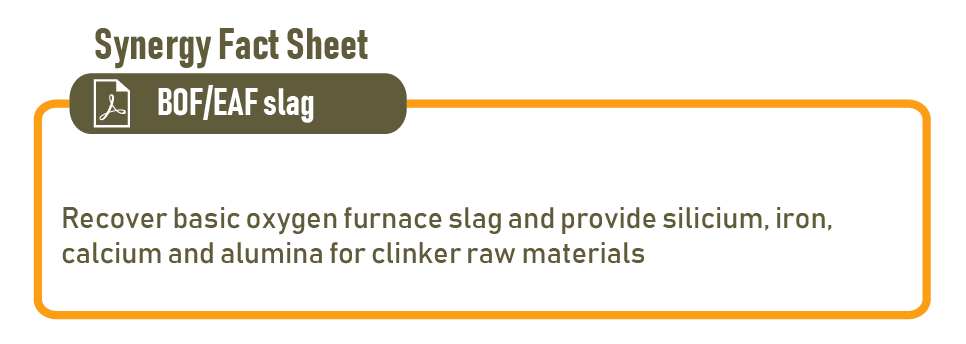
- A detailed breakdown of a selected high-impact IS synergy including a general description and technical objectives and overview of in-and- output sectors
- An evaluation of synergy feasibility and implementation,
- Insights into potential economic, environmental, and social impact of each synergy if implemented at the European level
See below to discover the 10 synergies and learn about them from the corresponding fact sheets






















THE EXISTING R&D LANDSCAPE FOR INDUSTRIAL SYMBIOSIS
The existing R&D landscape for Industrial Symbiosis is shaped by a growing portfolio of European research and innovation activities that support the transition from conceptual circular economy approaches to practical, scalable and standardisable solutions. Mapping EU-funded projects implemented between 2015 and 2027 highlights a core group of initiatives delivering pre-normative evidence, technical solutions, digital tools and policy insights directly relevant to industrial symbiosis standardisation. Together, these projects demonstrate where R&D maturity already enables the development of harmonised concepts, performance metrics and data interoperability, while also revealing remaining gaps where further research and coordination are needed to accelerate cross-sector adoption and replication of industrial symbiosis across Europe.
Download: Factsheet “Current Landscape of R&I Activities for Industrial Symbiosis Standardisation” [PDF]
From Expertise to Standards: Working Groups Behind the IS Standardisation
The development of the Industrial Symbiosis Standardisation Roadmap is informed by 10 thematic Working Groups convened throughout 2025. These groups bring together experts from industry, research, policy and standardisation bodies to identify gaps, opportunities and recommendations for IS standardisation.
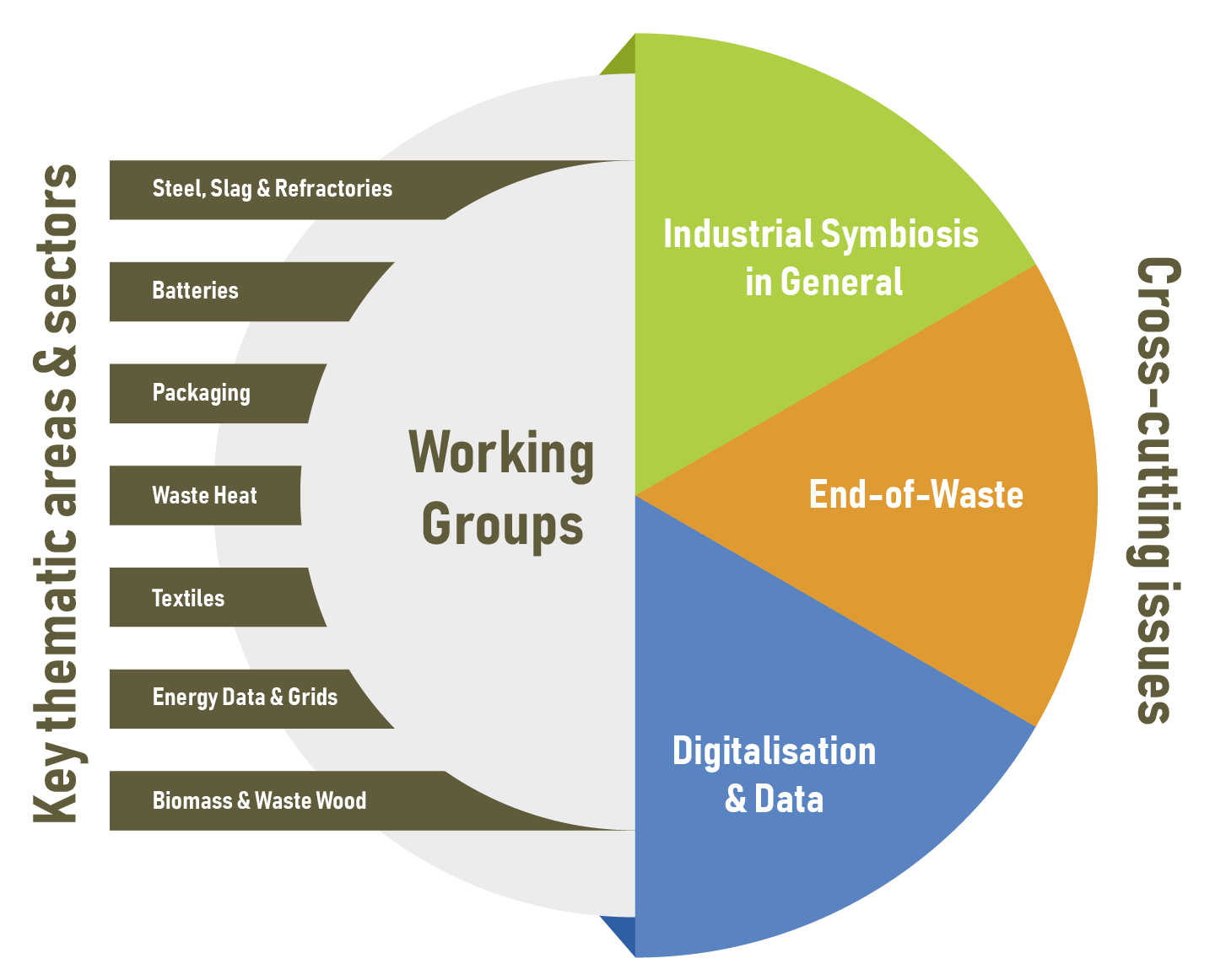
Horizontal Working Groups address cross-cutting challenges and enablers that apply across sectors:
- Industrial symbiosis in general
- End-of-Waste
- Digitalisation and data interoperability
Vertical Working Groups focus on priority sectoral pathways where standards can unlock high-potential symbiotic exchanges:
- Steel, slag & refractories
- (EV) Batteries
- Packaging
- Waste heat
- Textiles
- Energy data & grids
- Biomass
These Working Groups have engaged participants through staged workshops to review evidence, validate needs and draft preliminary recommendations that will feed into the roadmap. A Plenary Meeting held in November 2025 at the EIT House in Brussels served to consolidate outputs from all groups and defined the next steps towards consultation and finalisation in 2026.
Consultation Completed: Thank You for Your Feedback on the Draft IS Standardisation Roadmap
Draft Roadmap and Consultation
The public consultation on the RISERS Industrial Symbiosis Standardisation Roadmap has now been completed. The draft roadmap was made available for public review to gather feedback from stakeholders across industry, research, policy, standardisation and technical communities.
The roadmap synthesises findings from RISERS Working Groups, an assessment of the current standardisation landscape, and high-impact industrial symbiosis synergies identified across Europe. It aims to clarify where standardisation can support industrial symbiosis, where existing standards and processes can be better used, and where targeted action may be needed.
Consultation Process
Stakeholders were invited to provide input on the draft roadmap by 30 June 2026. The consultation included public feedback as well as targeted engagement with relevant standardisation actors, including selected CEN and CENELEC Technical Committees.
The feedback received will now be reviewed and analysed by the RISERS consortium. It will support the refinement of the roadmap and help ensure that the final document reflects practical needs, technical feasibility and the perspectives of the communities involved in industrial symbiosis implementation and standardisation.
Roadmap and Contact:
- Draft IS Standardisation Roadmap
- Consultation status: Closed
- Feedback deadline: 2026-06-30
- Contact: svogel@cencenelec.eu
Next Steps
The RISERS consortium would like to thank all stakeholders who contributed to the consultation process. Your input will help shape actionable standardisation priorities supporting resource efficiency, interoperability and the wider adoption of industrial symbiosis across European value chains.
The final Industrial Symbiosis Standardisation Roadmap is planned for publication in December 2026.