Insights from the RISERS Final Conference.
On 3 November 2026, the RISERS Final Conference brought together representatives from industry, research, policymaking and standardisation at EIT House, Brussels and online to discuss how Europe can accelerate industrial symbiosis across sectors. The conference welcomed 36 participants in person, with a further 42 participants joining online. The event marked an important milestone as RISERS approaches the end of its three-year journey.
The discussions centred on a question posed at the beginning of the conference by RISERS project coordinator Andrea Motola: if industrial symbiosis makes so much sense, why is it still so difficult to implement at scale?
From gaps and barriers to a standardisation roadmap
The first part of the conference presented the journey behind the RISERS Industrial Symbiosis Standardisation Roadmap, bringing together the different strands of work carried out by the project.
RISERS started from the recognition that industrial symbiosis is not simply a technical challenge. By its nature, industrial symbiosis is a cross-sector activity which introduces complexity compared to conventional industrial processes. Differences in terminology, processes and requirements, together with difficulties around data sharing, regulation and coordination between stakeholders, can prevent promising resource exchanges from being replicated and scaled. This is why standards are the right tool to bridge over these gaps: When properly set, standards provide common language, compatible approaches and greater confidence between actors from different sectors.
RISERS brought together research, policy analysis, stakeholder engagement and standardisation expertise to develop its Industrial Symbiosis Standardisation Roadmap. An initial database of around 600 industrial synergies was progressively assessed to identify priority areas with economic, environmental and social potential. This evidence was complemented by analysis of existing standards, regulation and real-life industrial symbiosis cases and fed into the thematic work that ultimately informed the roadmap.
The conference also underlined that the roadmap should not serve as an endpoint. Its value will depend on stakeholders taking its recommendations forward through technical committees, policy discussions, research activities and new cross-sector collaborations. Crucially, the roadmap can also be viewed as a test case for a methodology to identify points of friction and determine how standardisation can help address them in industrial symbiosis.
Setting the scene for the policy discussion, William Neale, Adviser on Circular Economy at the European Commission’s DG ENV, provided a keynote perspective on developments at EU level and the evolving policy context for circularity and industrial symbiosis.
Policy and regulation: creating the conditions to scale
The first panel focused on the policy context and highlighted one of the recurring themes of the day: successful examples of industrial symbiosis already exist but replicating them across Europe requires more consistent enabling conditions.
In particular, participants returned repeatedly to end-of-waste and by-product rules and the challenges created by different requirements across European countries and regions. Harmonised approaches, greater transparency and clearer quality requirements can make it easier for secondary resources to move between companies and across borders. The discussion was particularly timely in view of the upcoming Circular Economy Act.
At the same time, the discussion made clear that standards cannot resolve these challenges on their own. Participants stressed the need for a stable legislative framework and end-user expectations, with standards complementing regulation by providing flexible and targeted technical solutions. The interaction between legislation, standards and financing was identified as particularly important for creating the predictability and investment conditions needed to establish new circular value chains.
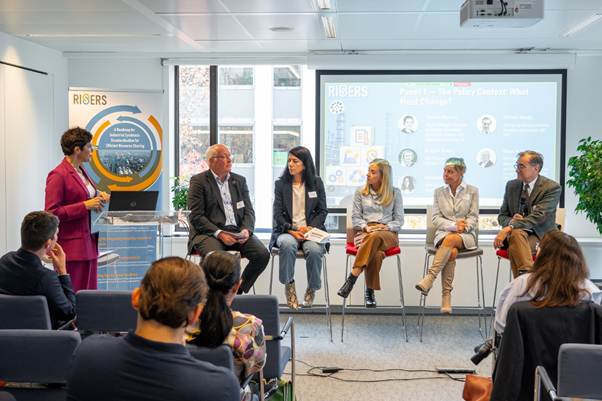
The panel also highlighted the role of reliable data. Standards can provide the infrastructure and common approaches needed to exchange information on material composition, traceability and supply chains, helping to build the trust necessary for companies to engage in industrial symbiosis.
Following the policy discussion, Rachel Lombardi, Chief Executive of International Synergies Limited and Convenor of CEN/TC 465/WG 4 on Industrial Symbiosis for Sustainable Cities and Communities, delivered a keynote on the benefits of standardisation in facilitating industrial symbiosis.
Connecting research, innovation and standardisation
The afternoon turned to the role of research and innovation in developing the solutions that could underpin future standards.
The discussion highlighted the timeline mismatch between research and standardisation. Typically, research results arrive the standardisation stage when the project is finalised which could lead to lack of involvement from the R&I community. Moreover, researchers are not always familiar with standardisation or its economic importance, while standardisation processes do not automatically capture relevant results from R&I projects. Participants therefore called for greater awareness of standardisation within research organisations, stronger capacity building, and more systematic involvement of standardisation expertise in R&I activities.
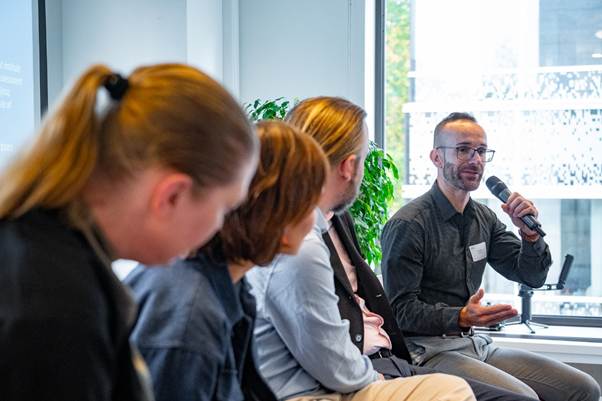
Pre-normative research was highlighted as an important bridge. Instruments such as workshop agreements can provide a means of capturing emerging technical knowledge before a full standard is appropriate, particularly in fast-evolving areas. At the same time, participants stressed that developing such outputs is only part of the challenge: industry and external experts need to be involved while the visibility and subsequent uptake of the resulting documents must be strengthened.
The panel ultimately pointed towards a more continuous relationship between research and standardisation, in which researchers consider standardisation as part of the pathway towards impact rather than only towards the end of a project.
What does industry need?
The final panel brought the discussion back to the practical reality of implementing industrial symbiosis.
Identifying a technically possible exchange is only the first step: companies still need to identify appropriate partners, establish trust, align requirements and develop a viable business case. Facilitators can help bridge these organisational and coordination gaps, while standards can provide common terminology, methods and requirements that make collaboration between companies and sectors easier to establish and replicate.
The discussion also underlined the need to treat industrial symbiosis as a business activity. Exchanges must work commercially for the companies involved, and standards and regulation should help create appropriate conditions rather than prescribe the commercial relationship between partners. Clear and enabling rules, investment frameworks and approaches that allow secondary resources to compete on the basis of their performance were among the issues raised.
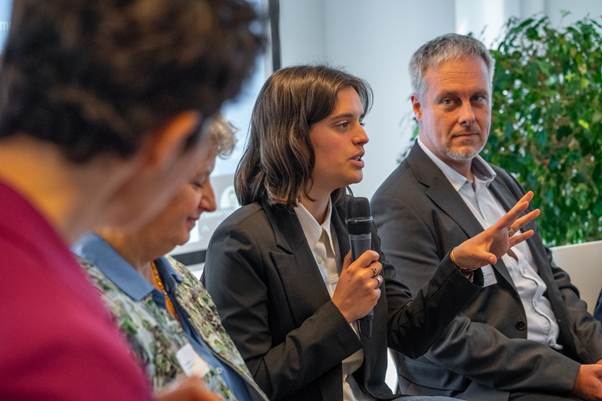
Finally, participants stressed the importance of communicating the economic case for industrial symbiosis more effectively. Resource efficiency, competitiveness, decarbonisation, inward investment and regional economic development should not be treated as separate objectives. Industrial symbiosis can contribute to all of them, and connecting these benefits more clearly to policy and investment priorities will be important for wider uptake.
From the RISERS roadmap to the next steps
As RISERS approaches its conclusion, its roadmap and the connections established throughout the project provide a foundation for continued collaboration, helping translate standardisation priorities into practical action across Europe. Europe needs to strengthen the conditions that allow collaboration to happen more easily, more consistently and at a larger scale.
Three priorities emerged for the community:
- Translate the roadmap recommendations into concrete standardisation activities, including work in relevant technical committees and standardisation programmes.
- Maintain the connections between industry, research, policymakers and standardisation created through RISERS beyond the lifetime of the project.
- Make better use of research and innovation results by developing stronger mechanisms to transfer knowledge from projects into standardisation processes.
The conference therefore marked not only the closing phase of RISERS, but also the starting point for the next stage of its work. As RISERS approaches its conclusion, its roadmap and the connections established throughout the project provide a foundation for continued collaboration, helping translate standardisation priorities into practical action across Europe.
The RISERS consortium thanks all speakers, panellists, Advisory Board members and participants who contributed to the conference and to the project’s work over the past three years.
Revisit the RISERS Final Conference
Presentations and a photo gallery from the event are available here:
https://risers-project.eu/save-the-date-risers-final-conference/