
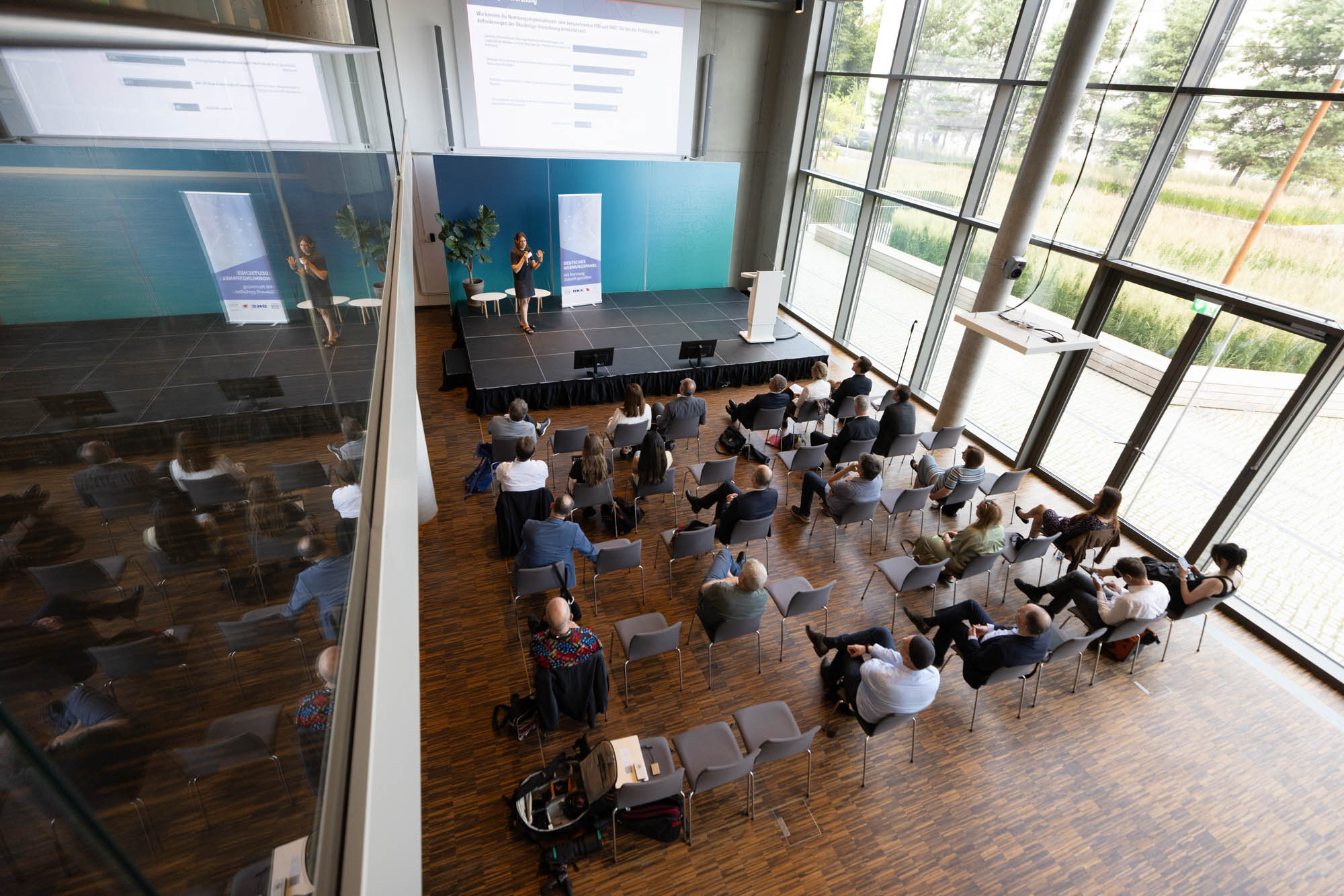
On 23 June 2026, the results of the 13th round of the German Standardisation Panel (DNP) (https://www.normungspanel.de/en/) were presented to the public.
To promote research in the field of standardisation, the DNP was established in autumn 2011 to gain a deeper understanding of the processes and impacts of standardisation through scientifically sound findings. The DNP’s annual surveys provide a vital data foundation for analysing standardisation activities in Germany and enable research into the impact of standards on various economic and social sectors. Since the first wave, every year between 1.000 and 2.000 standardisation stakeholders are participating in the survey. Today, the DNP is supported by the standardisation organisations DIN and DKE and managed by the Chair of Innovation Economics at the Technical University of Berlin. Since 2016, the DNP has been under the patronage of the German Federal Ministry for Economic Affairs and Energy (BMWE).
The annual survey consists of a fixed core questionnaire and a topic-specific special section. In the current survey, particular focus was placed on the circular economy.
The results of the 2026 edition show that the circular economy is generally regarded as an important issue by the organisations surveyed. Around two-thirds of them view the circular economy in at least a somewhat positive light.
Standardisation is recognised as being important. Nevertheless, active participation has so far been limited to a relatively small group of stakeholders and has focused primarily on national and European processes.
In addition, respondents cite several areas where either standards are lacking or existing regulations need to be further developed. Recycled materials and secondary raw materials are mentioned particularly frequently.
In line with RISERS’ descriptions in the draft Roadmap for Industrial Symbiosis Standardisation, issues relating to data availability and interoperability in connection with circular economic transactions and Digital Product Passports (DPP) are regarded as being of great importance. The findings make it clear that there is a particular need for further standardisation where new requirements arise in relation to circularity, transparency and product life cycles. At the same time, the close link between circular economic transactions and digital infrastructures was highlighted.
In addition, the study presents numerous stakeholder needs related to the Ecodesign Regulation and shows how measures such as standardisation can help address them.
Overall, the results show that many companies recognise the potential of standards in the development of the circular economy. At the same time, there remains a need for practical solutions and a reliable regulatory framework. RISERS aims to provide solutions to support industrial symbiosis, which may also improve the framework conditions for circular economic transactions in this context.